

2026 Corvette E-Ray: The Hybrid AWD Corvette Explained
Last updated: September 21, 2026 | Service area: Denver, Lakewood, and the Colorado Front Range
For seventy years the Corvette sent its power to the rear wheels and asked you to be careful in the rain. The E-Ray ended that. It is the first all-wheel-drive Corvette and the first electrified one, and it does the job in an unusual way: a naturally aspirated 6.2L V8 still drives the rear axle, while a separate electric motor drives the front. There is no plug, no charging routine and no compromise on the V8 soundtrack. What there is, for a Denver owner, is a mid-engine sports car you can drive in November.
Quick Answer
The Corvette E-Ray is a hybrid all-wheel-drive Corvette that pairs the 6.2L LT2 V8 driving the rear wheels — 495 horsepower and 470 lb-ft — with a 160-horsepower electric motor driving the front wheels, for a combined 655 horsepower. A 1.9 kWh lithium-ion battery sits between the seats and recharges through braking, coasting and normal driving, so the car never plugs in. Chevrolet rates it at 2.5 seconds to 60 mph and 10.5 seconds through the quarter mile at 130 mph. The 2026 E-Ray starts at $108,600 for the 1LZ coupe, comes standard with carbon ceramic brakes, Magnetic Ride Control 4.0 and Michelin all-season tires, and is the final model year before the 2027 Grand Sport X takes over the hybrid all-wheel-drive role.
Explore Corvette at Emich Chevrolet
Top-rated Chevrolet dealer in Denver and Lakewood. Best selection, best pricing, and the Front Range’s most trusted Chevy sales and service team.
What Makes the E-Ray Different From Every Other Corvette
The E-Ray is the only sports car on sale that pairs a naturally aspirated V8 with an electrified all-wheel-drive system, and the reason becomes clear once you look at how the halves are arranged. The LT2 6.2L Small Block sits behind the cabin and drives the rear wheels through an eight-speed dual-clutch transmission, exactly as in a Stingray. The front axle has no mechanical connection to the engine at all — no driveshaft, no transfer case, just a compact permanent-magnet motor and a single gearset.
That layout is why the E-Ray keeps its front trunk: Chevrolet’s front drive unit is compact enough not to eat the space a mechanical all-wheel-drive conversion would, and total cargo volume stays at 12.5 cubic feet. It is also why the car still sounds like a Corvette — no turbocharger muffling the intake, no engine-off creeping at part throttle. The electric motor works in concert with the LT2 rather than replacing any part of its voice.
The widebody it shares with the Z06
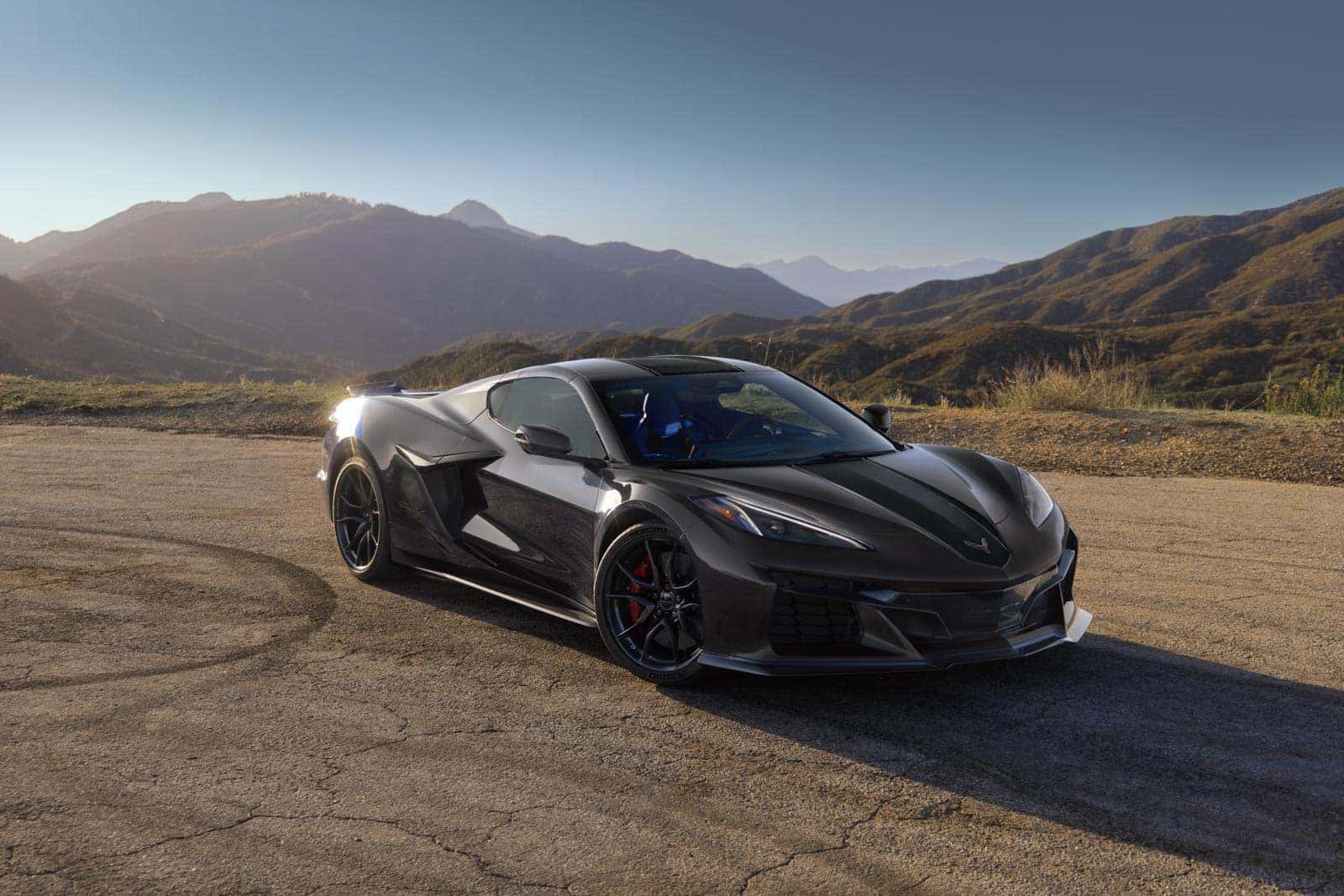
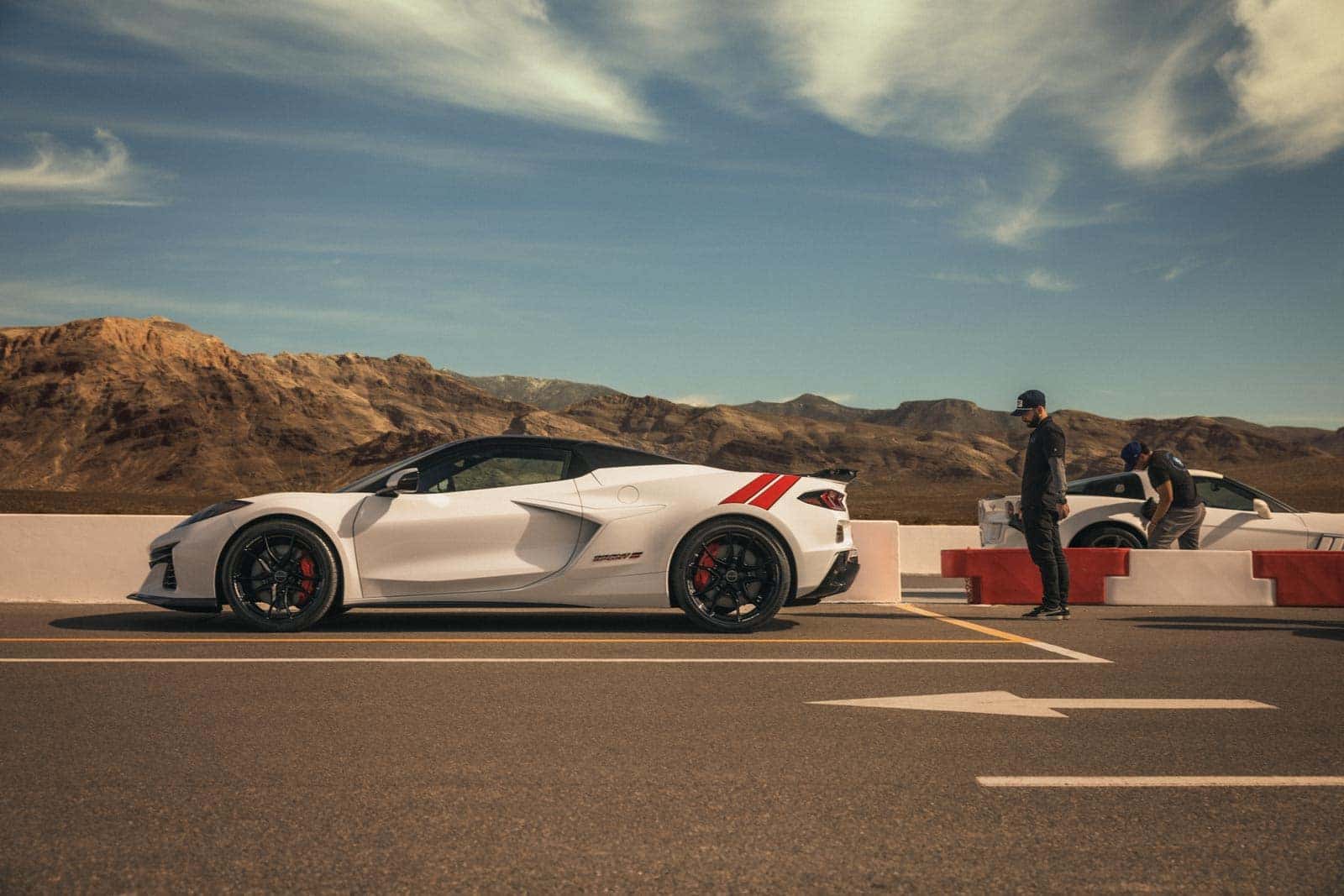
The E-Ray uses the Z06’s wide-body proportions — 3.6 inches wider overall than a Stingray — because it needs the same enormous contact patches to put 655 horsepower down. Wheels are staggered 20 x 10 inches front and 21 x 13 inches rear on 275/30ZR20 and 345/25ZR21 tires, in a twisted five-spoke star design exclusive to the E-Ray.
How the Hybrid System Actually Works
This is the part most shoppers get wrong. The E-Ray is not a plug-in hybrid and not an electric car with a gas engine for backup — it is a performance hybrid whose battery exists to feed a traction motor, not to deliver electric range. The 1.9 kWh lithium-ion pack sits in the center tunnel between the seats; a plug-in hybrid SUV typically carries fifteen to twenty times that capacity. It charges from regenerative energy under braking and coasting and during ordinary driving, and it is designed to be repeatedly drained and refilled over a drive rather than topped up overnight.
The eAWD control system constantly reads the road surface and adapts, sending additional power to the front wheels in hard driving or low-traction conditions and doing very little at a dry-road cruise. The motor also plays into efficiency: the LT2’s Active Fuel Management can shut down four cylinders, and the front motor covers the torque gaps that would otherwise force all eight back online.
| Specification | Chevrolet Corvette E-Ray |
|---|---|
| Engine | LT2 6.2L V8, naturally aspirated, direct injection, Active Fuel Management |
| Engine output | 495 hp @ 6,450 rpm / 470 lb-ft @ 5,150 rpm (rear axle) |
| Electric motor | Permanent-magnet drive motor, 160 hp / 125 lb-ft (front axle) |
| Combined power | 655 hp (481 kW) |
| Battery | 1.9 kWh lithium-ion, no plug-in charging |
| Transmission | MLH 8-speed dual-clutch |
| Drive | eAWD (electric front axle, V8 rear axle) |
| 0–60 mph | 2.5 seconds |
| Quarter mile | 10.5 seconds @ 130 mph |
| Max lateral grip | 1.1g (300-ft skid pad, summer tires) |
| Brakes | Standard Brembo carbon ceramic; 6-piston front / 4-piston rear monobloc calipers |
| Rotor size | 15.7 x 1.5 in front / 15.4 x 1.3 in rear |
| Suspension | SLA double wishbone front and rear; Magnetic Selective Ride Control 4.0 |
| Wheels / tires | 20 x 10 in / 21 x 13 in; 275/30ZR20 front, 345/25ZR21 rear |
| Dry weight | 3,774 lbs coupe / 3,856 lbs convertible |
| Cargo volume | 12.5 cu ft |
| Fuel tank | 18.5 gallons |
| Dimensions (L / W / H) | 184.6 in / 79.7 in / 48.6 in; 107.2-in wheelbase |
| Turning circle | 36.4 ft |
| Body styles | Removable-roof coupe or retractable hardtop convertible |
Stealth Mode, Charge+ and the Six Drive Modes
The E-Ray gives the driver two electric-specific console buttons, and they solve genuinely different problems.
Stealth Mode is selected at start-up and lets the car pull away on electric power alone, up to 45 mph, so you can leave a neighborhood at six in the morning without waking anyone. The V8 fires automatically if you exceed that speed, request more torque than the motor can deliver, or run the battery down. It is a courtesy feature, not an EV range mode.
Charge+ does the opposite, maximizing the battery’s state of charge so electric assist is there when you want it. The intended use is track lapping, where repeated hard acceleration drains the small pack faster than regeneration refills it.
Beyond those, electric assist is tuned differently within each of six driver-selectable modes: Tour, Sport, Track, Weather, My Mode and Z-Mode, with Performance Traction Management calibrations developed alongside the eAWD system rather than carried over. An onboard E-Ray Performance App shows live power output from the motor and the V8, a power and torque dyno graph, and electrical system efficiency data.
Why eAWD Matters More in Colorado Than Almost Anywhere
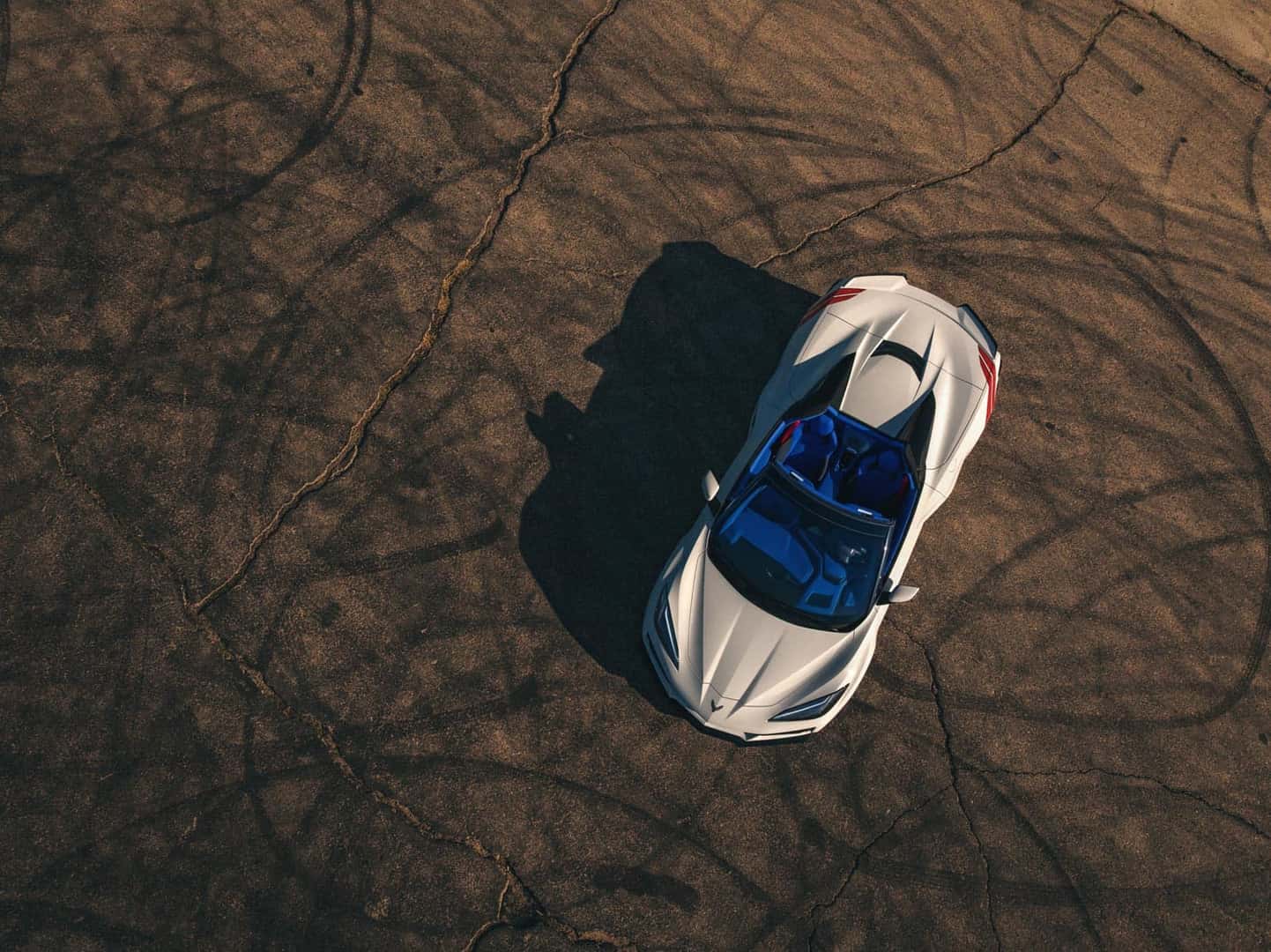
The performance numbers get the headlines, but the reason the E-Ray makes particular sense on the Front Range is traction — and it shows up in a spec most people skim past. The E-Ray comes standard on Michelin Pilot Sport all-season tires, with Pilot Sport 4S summer tires as the optional choice in a performance package. That is the reverse of how most 600-plus-horsepower sports cars are sold, and Chevrolet made the call deliberately: this was developed to be the Corvette an owner can arrive in no matter the season. All-season rubber plus an electrically driven front axle plus a Weather drive mode is a different proposition from a rear-drive Corvette on summer tires, which is effectively a garage ornament in Denver from November through March.
Two caveats, stated plainly. All-season is not winter: these are ultra-high-performance tires on very wide, very low-profile wheels, not a substitute for dedicated snow tires in an actual storm. And ground clearance is what it is on a car 48.6 inches tall — the available adjustable front lift with memory helps with driveway aprons and parking blocks, not with snowbanks. Where the E-Ray genuinely shines is the shoulder season and the mountain road: a cold, damp morning on US 285, a canyon road out of Golden with patchy shade, an October drive over a pass where the surface changes every mile.
Where the E-Ray Sits Between Stingray and Z06
The E-Ray is not a step up the power ladder from the Z06 — it is a different axis entirely. The Z06 is the track car; the E-Ray is the all-weather grand tourer that happens to be quicker of the two in a straight line.
| Model | Engine | Power | Drive | 0–60 mph |
|---|---|---|---|---|
| 2026 Stingray | LT2 6.2L V8 | 490 hp (495 hp with performance exhaust) | Rear-wheel drive | — |
| 2026 E-Ray | LT2 6.2L V8 + front electric motor | 655 hp combined | eAWD | 2.5 sec |
| Z06 | LT6 5.5L flat-plane-crank V8 | 670 hp | Rear-wheel drive | 2.6 sec |
Stingray and E-Ray figures are 2026 model year. Z06 figures are Chevrolet’s currently published lineup figures. Chevrolet updated the Stingray’s engine for 2027 to the naturally aspirated LS6 6.7L V8 rated at 535 horsepower.
The E-Ray’s argument comes straight out of that table: 15 horsepower down on the Z06 and a tenth quicker to 60, because traction beats output off the line — for meaningfully less money, in the only one of the three you would consider driving to dinner in a snow flurry. What the Z06 still owns is the sensory experience at the top of the tachometer, where the flat-plane-crank LT6 revs past 8,000 rpm and sounds like nothing else Chevrolet has built. Which of those you want is a preference, not a ranking.
2026 Is the Final E-Ray Year: What Replaces It
This is the single most important thing for a 2026 shopper to know. The E-Ray does not continue into 2027. Chevrolet’s current Corvette lineup is Stingray, Grand Sport, Grand Sport X, Z06, ZR1 and ZR1X — and the hybrid all-wheel-drive slot the E-Ray occupied now belongs to the Grand Sport X.
The Grand Sport X starts at $109,700 and produces a combined 721 horsepower, reaching 60 mph in 2.4 seconds and the quarter mile in 10.4 seconds at 131 mph. Chevrolet describes it as blending naturally aspirated power, electrified performance and all-weather capability — the same formula as the E-Ray, with a next-generation engine and more output.
That creates a clean decision. If you want the newest version of this idea with more power, wait for the Grand Sport X. If you want the original electrified AWD Corvette — the 2024 through 2026 run, the C8 generation’s LT2-based hybrid — the 2026 model year is the last chance to buy one new. Neither is a wrong answer; they are different purchases.
2026 E-Ray Pricing and Trims
The E-Ray comes in three equipment levels — 1LZ, 2LZ and 3LZ — as a coupe or a convertible. All three include carbon ceramic brakes and Magnetic Ride Control 4.0 as standard, so the walk up the range buys equipment and interior content rather than performance hardware.
| Trim | Coupe | Convertible |
|---|---|---|
| 1LZ | $108,600 | $115,600 |
| 2LZ | $114,100 | $121,100 |
| 3LZ | $119,550 | $126,550 |
2026 model year pricing including destination. Excludes tax, title, license, dealer fees and optional equipment. Dealer sets final price.
Personalization is where the money goes after that: four aluminum wheel finishes plus optional carbon fiber wheels, two carbon fiber trim packages, three seat choices, a long list of interior colors, available carbon fiber ground effects and double racing stripe packages. Configured thoroughly, a 3LZ convertible climbs well past its base figure.
Common Misunderstandings About the E-Ray
- “It’s a plug-in hybrid.” It is not. The 1.9 kWh battery charges only from regeneration and normal driving. There is no charge port and no charging routine.
- “It’s the fuel-economy Corvette.” The hybrid system exists for traction and acceleration. Efficiency gains from extended four-cylinder operation are a side effect, not the point.
- “Stealth Mode means real EV range.” It is capped at 45 mph and lasts a short distance. It is designed for leaving a quiet street, nothing more.
- “All-wheel drive means it’s a winter car.” It ships on all-season tires, not winter tires, and sits 48.6 inches tall. It extends the season substantially; it does not make the car a snow vehicle.
- “It’s slower than the Z06 because it has less horsepower.” The E-Ray is 15 hp down and one tenth quicker to 60 mph, because eAWD puts power down better from a standstill.
Living With an E-Ray Day to Day
The E-Ray is more usable than its numbers suggest. Cargo volume of 12.5 cubic feet split between the front and rear compartments holds two people’s weekend luggage or a set of golf clubs, which is not something you can say about most mid-engine cars. The interior is the C8’s driver-focused cockpit with a standard Head-Up Display, wireless Apple CarPlay and Android Auto compatibility, an available Performance Data and Video Recorder for track days and an optional 14-speaker Bose Performance Series system.
On maintenance, the hybrid hardware adds very little to the owner’s burden: no charging equipment to install, no plug-in conditioning routine, no EV-style high-voltage service interval. The LT2 uses a dry-sump oiling system with 7.5 quarts of Dexos 2 0W-40 synthetic — a more involved oil change than a typical car, but routine for a shop that works on Corvettes. What catches owners out is tires: at 275/30ZR20 front and 345/25ZR21 rear these are large, expensive and low-profile, and the rear pair in particular will not last long if the car is driven the way it invites. The standard carbon ceramic rotors, by contrast, are extremely long-lived in street use.
Why Shop Corvette at Emich Chevrolet
Corvette is not a car you buy off a lot the way you buy a crossover. Allocation, configuration and timing all matter, and a final-model-year variant makes that more true, not less. Emich Chevrolet has sold and serviced Chevrolet on the Front Range for decades, and our team can walk you through what is realistically available, what a specific build costs, and how the E-Ray compares against the Grand Sport X for how you actually plan to drive.
We will tell you plainly when a Stingray is the smarter purchase for your use case, or when waiting for the 2027 lineup makes more sense than buying now. On the service side, our technicians work on Chevrolet performance cars regularly — the dry-sump oil service, the carbon ceramic brake inspections, the alignment work a car on 345-section rear tires actually needs. Come drive one and see whether the eAWD argument holds up for you on a cold Colorado morning, because that is the specific thing this car was built to do.
Key Takeaways
- The Corvette E-Ray is the first all-wheel-drive and first electrified Corvette, combining a 495-hp LT2 6.2L V8 at the rear with a 160-hp electric motor at the front for 655 combined horsepower.
- It never plugs in. The 1.9 kWh battery recharges through braking, coasting and normal driving.
- Chevrolet rates it at 2.5 seconds to 60 mph and 10.5 seconds at 130 mph through the quarter mile — a tenth quicker to 60 than the more powerful Z06.
- Carbon ceramic brakes, Magnetic Ride Control 4.0 and Michelin all-season tires are standard; summer tires are the option.
- Stealth Mode allows electric-only driving up to 45 mph; Charge+ maximizes battery state of charge for track use.
- 2026 pricing runs from $108,600 for the 1LZ coupe to $126,550 for the 3LZ convertible.
- 2026 is the final E-Ray model year. The 2027 Grand Sport X takes over the hybrid AWD role with 721 combined horsepower from $109,700.
Corvette E-Ray FAQs
Does the Corvette E-Ray need to be plugged in?
No. The E-Ray has no charge port. Its 1.9 kWh lithium-ion battery, mounted between the seats, is recharged by regenerative energy from braking and coasting and during ordinary driving. It is a performance hybrid designed to feed a traction motor, not a plug-in hybrid designed to deliver electric range, so there is no charging equipment to install at home.
How much horsepower does the Corvette E-Ray have?
A combined 655 horsepower. The 6.2L LT2 V8 contributes 495 horsepower and 470 lb-ft of torque to the rear axle, and a permanent-magnet electric motor adds 160 horsepower and 125 lb-ft at the front axle. The two systems are mechanically independent — there is no driveshaft connecting the engine to the front wheels.
How fast is the Corvette E-Ray?
Chevrolet rates the E-Ray at 2.5 seconds to 60 mph and 10.5 seconds through the quarter mile at 130 mph, both based on initial vehicle movement. Maximum lateral grip is 1.1g on a 300-foot skid pad when equipped with the available summer-only performance tires. When it launched, it was the quickest production Corvette in history.
Is the Corvette E-Ray all-wheel drive?
Yes, and it is the first all-wheel-drive Corvette ever built. Chevrolet calls the system eAWD: the V8 drives the rear wheels through an eight-speed dual-clutch transmission while an electric motor drives the front wheels. The control system continuously reads the road surface and sends additional power forward during spirited driving or in low-traction conditions.
Can you drive a Corvette E-Ray in Colorado winters?
It extends the season considerably but it is not a snow car. The E-Ray comes standard on Michelin Pilot Sport all-season tires rather than summer rubber, and eAWD plus a Weather drive mode makes cold, wet and patchy roads far more manageable than in a rear-drive Corvette. However, all-season is not winter tire, and a car 48.6 inches tall has limited clearance in unplowed snow.
What is Stealth Mode on the Corvette E-Ray?
Stealth Mode is an all-electric drive mode selected at start-up that lets the E-Ray move under battery power alone up to 45 mph. It is designed for leaving a neighborhood quietly early in the morning. The V8 engages automatically if you exceed that speed, request more torque than the electric motor can supply, or deplete the battery pack.
How much does a 2026 Corvette E-Ray cost?
2026 E-Ray pricing including destination runs $108,600 for the 1LZ coupe, $114,100 for the 2LZ coupe and $119,550 for the 3LZ coupe. Convertibles add $7,000 at each level: $115,600, $121,100 and $126,550 respectively. Carbon ceramic brakes and Magnetic Ride Control 4.0 are standard on every trim, so the higher levels buy equipment and interior content rather than performance hardware.
Is the E-Ray faster than the Corvette Z06?
To 60 mph, yes — 2.5 seconds versus the Z06’s 2.6 — despite the E-Ray making 655 combined horsepower against the Z06’s 670. All-wheel drive puts power down better from a standstill. The Z06 is the sharper track instrument, with a flat-plane-crank LT6 5.5L V8 that revs far higher and a chassis tuned for lap times rather than all-weather usability.
Is 2026 the last year for the Corvette E-Ray?
Yes. The E-Ray is not carried into the 2027 Corvette lineup, which consists of Stingray, Grand Sport, Grand Sport X, Z06, ZR1 and ZR1X. The hybrid all-wheel-drive role passes to the Grand Sport X, which starts at $109,700 and produces 721 combined horsepower with a 2.4-second 0-60 time. Buyers who want the original LT2-based electrified AWD Corvette need a 2026 model year car.
How much cargo space does the Corvette E-Ray have?
12.5 cubic feet total, split between the front storage compartment and the area behind the engine. The E-Ray keeps its front trunk because the electric motor over the front axle is compact enough not to intrude — an advantage over all-wheel-drive layouts that route engine torque forward mechanically. It is enough for two people’s weekend luggage.
Explore Corvette at Emich Chevrolet
Top-rated Chevrolet dealer in Denver and Lakewood. Best selection, best pricing, and the Front Range’s most trusted Chevy sales and service team.
Acceleration figures are based on initial vehicle movement. Lateral grip measured on a 300-foot skid pad with available summer-only performance tires; do not use summer-only tires in winter conditions. Pricing is manufacturer’s suggested retail price and excludes tax, title, license, dealer fees and optional equipment; dealer sets final price. Availability and specifications subject to change.